Can You Send Photos to an AI Companion? What It Can See — and What It Shouldn’t Invent
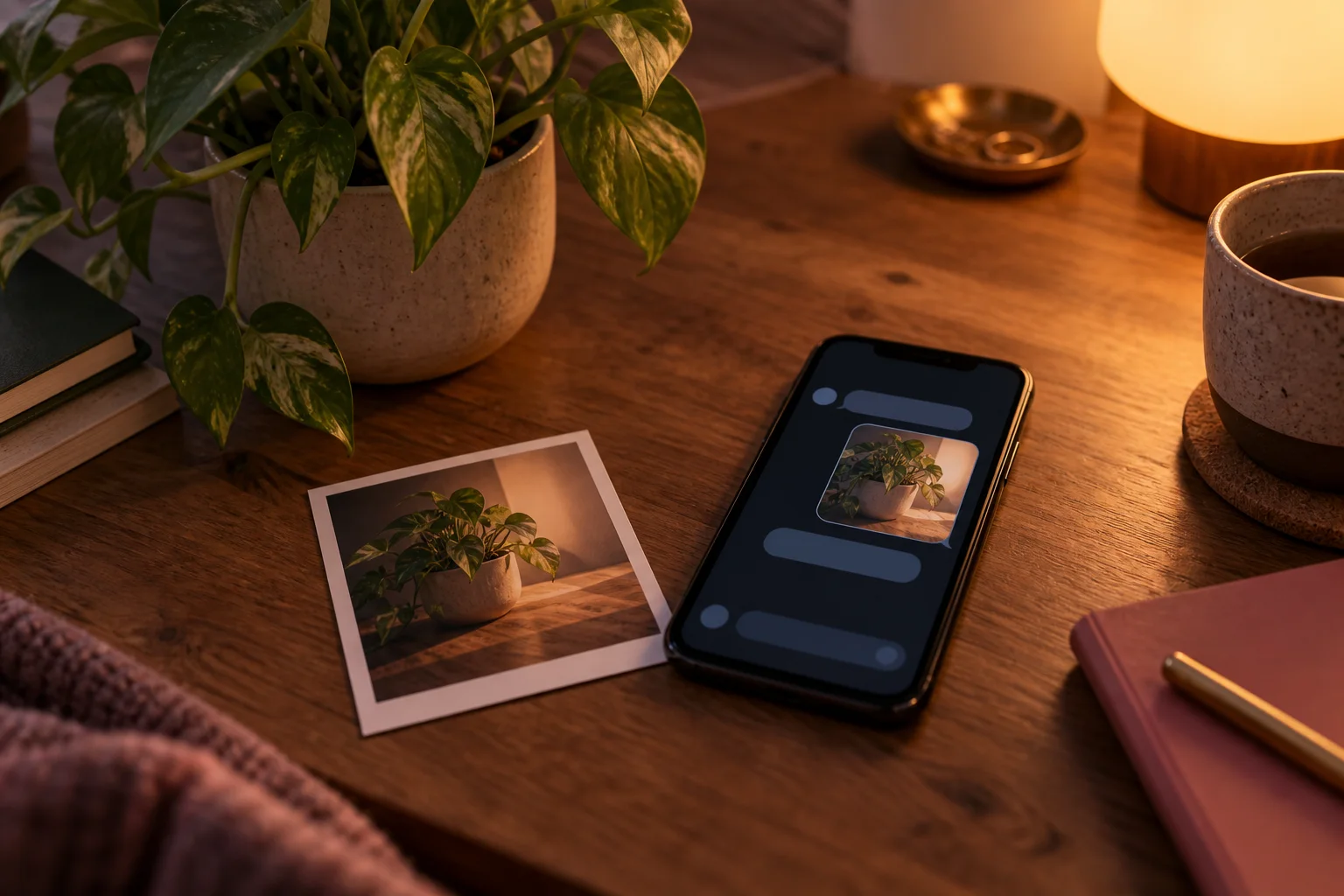
The useful test is narrower: can the system notice relevant details in the selected image, avoid inventing what is not visible, and turn those observations into a reply that still sounds like the character you were talking to?
On Tendera, signed-in users can share a selected photo in a conversation on Web and iPhone. Sophia, Mia, Elena, Jade, and custom characters can respond to shared images. Requested character-photo generation is a separate feature available for the four Tendera originals.
Sending a photo and asking for one are different
“Photo chat” can describe two opposite actions.
In the first, you send something from your life. It might be a plant with yellow leaves, a meal you tried to cook, a view from a train, or a jacket you are considering. The system has to analyze the selected image and use that information in the reply.
In the second, you ask the character to create a new picture. The system has to generate an image that follows the request while keeping the character recognizable.
Both directions involve images, but they fail differently. Image understanding can misread an object or infer too much from a partial view. Image generation can change a face, ignore the requested setting, or add details that were never requested. A provider that performs well at one task does not automatically solve the other.
Our earlier GPT Image 2.5 and Gemini photo article focuses mainly on the generation side. This article is about what happens when the picture begins with you.
Visible evidence has a boundary
Imagine a photo of a potted plant beside a window. The leaves are visible. The pot is visible. Afternoon light may be visible. The image may support a cautious observation that some leaves look pale.
It does not prove who bought the plant, how long it has been there, whether the apartment is yours, or why you took the picture. A confident story about those details would be invention, not understanding.
The same boundary applies to more personal images. A facial expression does not reveal a complete emotional state. A room does not reveal who lives there. A plate of food does not establish who cooked it or whether it tasted good.
A useful AI reply distinguishes three things:
That last category is where conversation begins. Asking “Were you worried about the leaves?” is more honest than declaring that the plant is dying and the sender has neglected it.
An accurate inventory can still be a bad reply
Image understanding is often demonstrated as a list: one plant, one ceramic pot, one wooden desk, warm indoor lighting.
The list may be correct and still feel useless in a conversation.
An AI companion has another assignment. It needs to decide which visible detail matters to the message and respond from a recognizable point of view. If every character produces the same neutral inventory, the photo feature has flattened the people it was supposed to extend.
Consider two illustrative replies to that plant photo. These are fictional examples, not user messages or production logs:
> The leaves nearest the window look healthier than the ones turned toward the room. Were you asking because you noticed the color changing?
> Okay, I see why you sent this. That one pale leaf is making the whole plant look more dramatic than it probably is. How long have you had it?
Both replies can be grounded in the same image. They choose different details and create different openings for the next message. That difference is part of character writing, not object recognition.
This is also why a character should be allowed to say that she is unsure. A careful question can preserve both accuracy and personality.
Five photos make a better test than one
If an app says its companion can understand pictures, try a small range rather than one perfect image.
1. A simple object
Send a clear photo of something ordinary: a mug, a plant, a book cover, or a pair of shoes. Ask a specific question and see whether the answer addresses it instead of merely listing objects.
2. An ambiguous scene
Use an image where the context is incomplete. Does the reply mark uncertainty, or invent a confident story about where you are and what happened?
3. Small readable text
Share a non-sensitive sign, label, or handwritten note. Image models can misread text, especially when it is small, angled, or partially hidden. Check the result yourself before relying on it.
4. A detail that matters to the character
Send the same safe image to two different characters. Do they choose different details and questions, or does the underlying image analysis make them sound interchangeable?
5. A follow-up without the image repeated
Continue the conversation. The photo should support the exchange rather than reset it. A useful system connects the visual detail to what you ask next without claiming perfect memory or knowledge.
None of these tests establishes medical, legal, safety, or professional reliability. An AI companion should not be your authority for diagnosing a condition, identifying a dangerous substance, or making another high-stakes decision from a photo.
Privacy starts before you tap send
The safest upload is still the one you chose carefully.
Avoid sharing passwords, identity documents, full payment details, private medical records, precise travel documents, or another person's sensitive information. Check mirrors, screens, mail, badges, and background text before sending an otherwise ordinary image.
Tendera accesses only the photo you select, not the rest of your library. The selected image is re-encoded to remove embedded metadata, stored privately with the conversation, and may be processed by the AI providers used to understand the image and generate a reply. Shared and generated photos remain part of chat history while the account is active and can be included in an account deletion request. The full current explanation belongs in our Privacy Policy, not in a promise that any internet service is perfectly secure.
That distinction matters: removing embedded metadata does not remove sensitive information visibly captured inside the picture. A street sign, reflection, document, or face is still part of the pixels.
What Tendera currently supports
As of September 16, 2026:
Free accounts currently include two total shared photos and two total generated character photos. Premium includes up to 20 shared photos per day and up to six generated character photos per day, with a limit of 60 generated photos per membership period. Current terms and limits are always shown on the Pricing page.
The feature is deliberately narrower than “the character sees everything.” You select one image. The system works with what is visible. The reply should remain honest about the rest.
The best result is not a long description of a photograph. It is a grounded observation that gives the same conversation somewhere new to go.
Ready to meet your AI companion?
Four unique personalities. Each one remembers you. Free to start.
Meet Your MatchKeep Reading
AI Girlfriend Without Sign Up: What Can You Actually Try First?
Looking for an AI girlfriend chat without creating an account? Learn what a real no-signup trial should reveal, what to protect, and how to judge the conversation before handing over your email.
AI Companion Voice Messages: What to Expect
Want to speak instead of type? See how AI companion voice messages work, what stays on screen, and how to choose when to read a reply or listen to it instead.
Why Your AI Girlfriend Forgets What You Said (2026)
She knew your dog's name Tuesday. By Friday, blank. That isn't forgetting — it's a sliding window. Here's what an AI companion keeps, and what it loses.
Frequently asked questions
Can I send a photo to an AI companion?⌃
Some AI companion apps support selected photo uploads in chat. On Tendera, signed-in users on Web and iPhone can share one selected photo in a message with an original or custom character.
Can an AI companion understand everything in a photo?⌃
No. An image model can identify visible objects, text, colors, people, and relationships with varying accuracy, but it can miss details and should not claim knowledge about anything outside the frame.
Does Tendera access my whole photo library?⌃
No. Tendera processes only the photo you choose to share. Selected photos are re-encoded to remove embedded metadata and stored privately with the conversation, as described in Tendera's Privacy Policy.
Can every Tendera character create new photos?⌃
No. Sophia, Mia, Elena, and Jade can create requested character photos on Web and iPhone. Custom characters can respond to a photo you share, but they do not currently generate character photos.